

qticamsrc is a hardware-accelerated GStreamer camera source plugin that provides direct access to Qualcomm’s Camera ISP (Image Signal Processor) capabilities through the camera service. It serves as the primary camera input element in Qualcomm’s GStreamer multimedia stack, enabling applications to acquire live frames from camera hardware and integrate them into multimedia, imaging, and AI processing pipelines.The plugin exposes Qualcomm camera ISP functionality through a standard GStreamer source interface, allowing applications to capture one or more camera streams in supported output formats while configuring both common capture settings and advanced ISP controls. This enables developers to build pipelines that combine camera acquisition with display, encoding, image capture, or downstream analytics processing.qticamsrc operates as a client of the camera service, which is responsible for managing the underlying camera Hardware Abstraction Layer (HAL) and coordinating access to camera hardware resources. This client-server design provides a scalable foundation for both multi-client and multi-camera deployments, allowing multiple applications or pipelines to access one or more physical camera devices concurrently, subject to platform capabilities.The plugin implements a request-pad, multi-output architecture with independently configurable video_%u and image_%u source pads. Each output pad can be configured with its own resolution, pixel format, frame rate, and codec-related settings, allowing a single camera session to produce multiple streams simultaneously. This makes it possible for one camera instance to support concurrent use cases such as:
live preview,
high-resolution video recording,
still-image capture,
machine learning inference pipelines.
qticamsrc supports multiple output formats to address both video and imaging use cases, including:
NV12 and NV21,
Raw Bayer,
NV12 with UBWC (Universal Bandwidth Compression),
JPEG output for snapshot capture.
The plugin also provides access to static and dynamic camera controls, enabling applications to configure image quality and other Qualcomm camera features directly through the GStreamer pipeline.Beyond single-camera operation, qticamsrc supports multi-camera and multi-client usage models. Multiple plugin instances can be used within the same application to acquire frames from different physical cameras, enabling deployment scenarios such as:
stereo camera processing,
side-by-side composition,
picture-in-picture,
independent parallel camera streams.
For snapshot workflows, qticamsrc supports dedicated image capture paths with snapshot stream types that include:
NV12 and NV21,
Raw Bayer,
JPEG blob output.
Internally, all camera access is coordinated through the camera service, which centralizes control of the camera HAL and associated ISP resources. This architecture simplifies resource management and enables scalable camera system designs, while the number of concurrently supported cameras and output streams remains dependent on the capabilities of the target Qualcomm chipset and ISP implementation and capabilities.
Capturing and streaming YUV frames for real-time display, or forwarding them directly to downstream encoding elements for preview and recording pipelines.
Producing multiple output streams from a single camera session, such as recording video while simultaneously capturing JPEG snapshots, and generating additional streams for AI inference, local storage, or network streaming.
Supporting high-frame-rate capture workflows, including pipelines operating above 60 FPS, with super-buffer mode used to reduce per-frame processing overhead in downstream elements.
Acquiring unprocessed sensor data for custom imaging pipelines, computational photography workflows, or computer vision applications that require direct access to raw camera output.
Accessing frames from multiple physical sensors, or working with coordinated camera configurations, for use cases such as stereo imaging, synchronized capture, and composite camera solutions.
Triggering single-shot or burst image capture workflows through GStreamer signals, with support for JPEG and RAW-based snapshot paths depending on platform configuration.
Format availability is determined at runtime from camera static metadata. Resolution ranges and maximum framerate are also dynamically populated from camera static metadata at plugin load time.
Antibanding mode to suppress flicker from artificial lighting: off, 50hz, 60hz, or auto.
Type: Enum Default: 3, "auto" Range: (0): off - The camera device will not adjust exposure duration to avoid banding problems. (1): 50hz - The camera device will adjust exposure duration to avoid banding problems with 50Hz illumination sources. (2): 60hz - The camera device will adjust exposure duration to avoid banding problems with 60Hz illumination sources. (3): auto - The camera device will automatically adapt its antibanding routine to the current illumination condition. Flags: readable/writable (changeable in PLAYING state) Example: antibanding="off" (or) antibanding=0
control-mode
Top-level 3A control switch. off disables all 3A routines, auto enables them, and use-scene-mode delegates to the scene mode setting.
Type: Enum Default: 1, "auto" Range: (0): off - Full application control of pipeline. (1): auto - Manual control of capture parameters is disabled. (2): use-scene-mode - Use a specific scene mode. (3): off-keep-state - Same as OFF mode, except that this capture will not be used by camera device background auto-exposure, auto-white balance and auto-focus algorithms (3A) to update their statistics. Flags: readable/writable (changeable in PLAYING state) Example: control-mode="off" (or) control-mode=0
custom-exposure-table
A serialized GstStructure string describing a custom exposure table (vendor tag org.codeaurora.qcamera3.exposuretable).
Type: String Default: NULL Flags: readable/writable (changeable in PLAYING state)
exposure-compensation
Exposure compensation in steps.
Type: Integer Default: 0 Range: -12 - 12 Flags: readable/writable (changeable in PLAYING state)
exposure-lock
Locks the current auto-exposure values, preventing further adjustments.
Type: Boolean Default: false Flags: readable/writable (changeable in PLAYING state)
exposure-metering
Exposure metering algorithm: average, center-weighted, spot, or custom.
Type: Enum Default: 0, "average" Range: (0): average - The camera device's exposure metering is calculated as average from the whole frame. (1): center-weighted - The camera device's exposure metering is calculated from the center region of the frame. (2): spot - The camera device's exposure metering is calculated from a chosen spot. (6): custom - The camera device's exposure metering is calculated from a custom metering table. Flags: readable/writable (changeable in PLAYING state) Example: exposure-metering="average" (or) exposure-metering=0
exposure-mode
Auto-exposure mode. Set to off to use manual exposure time.
Type: Enum Default: 1, "auto" Range: (0): off - The auto exposure routine is disabled. Manual exposure time will be used set via the 'exposure-time' property (1): auto - The auto exposure routine is active. Flags: readable/writable (changeable in PLAYING state) Example: exposure-mode="off" (or) exposure-mode=0
focus-mode
Auto-focus mode: off, auto, macro, continuous, or edof.
Type: Enum Default: 0, "off" Range: (0): off - The auto focus routine is disabled. (1): auto - The auto focus routine is active. (2): macro - In this mode, the auto focus algorithm is optimized for focusing on objects very close to the camera. (3): continuous - In this mode, the AF algorithm modifies the lens position continually to attempt to provide a constantly-in-focus image stream. (4): edof - The camera device will produce images with an extended depth of field automatically; no special focusing operations need to be done before taking a picture. Flags: readable/writable (changeable in PLAYING state) Example: focus-mode="auto" (or) focus-mode=1
iso-mode
ISO sensitivity mode. Set to manual to use manual-iso-value.
Type: Enum Default: 0, "auto" Range: (0): auto - The ISO exposure mode will be chosen depending on the scene. (1): deblur - The ISO exposure sensitivity set to prioritize motion deblur. (2): 100 - The ISO exposure sensitivity set to prioritize level 100. (3): 200 - The ISO exposure sensitivity set to prioritize level 200. (4): 400 - The ISO exposure sensitivity set to prioritize level 400. (5): 800 - The ISO exposure sensitivity set to prioritize level 800. (6): 1600 - The ISO exposure sensitivity set to prioritize level 1600. (7): 3200 - The ISO exposure sensitivity set to prioritize level 3200. (8): manual - The ISO exposure value provided by manual-iso-value will be used. Flags: readable/writable (changeable in PLAYING state) Example: iso-mode="deblur" (or) iso-mode=1
manual-exposure-time
Manual exposure time in nanoseconds. Active only when exposure-mode=off.
Type: Integer64 Default: 33333333 Range: 0 - 9223372036854775807 Flags: readable/writable (changeable in PLAYING state)
manual-iso-value
Manual ISO value. Active only when iso-mode=manual.
Type: Integer Default: 800 Range: 100 - 3200 Flags: readable/writable (changeable in PLAYING state)
manual-wb-settings
A serialized GstStructure string for manual white balance settings (color temperature or RGB gains). Used with manual-cc-temp or manual-rgb-gains modes.
Type: String Default: NULL Flags: readable/writable (changeable in PLAYING state)
white-balance-lock
Locks the current auto white-balance values.
Type: Boolean Default: false Flags: readable/writable (changeable in PLAYING state)
white-balance-mode
White balance mode. Supports auto, daylight, incandescent, fluorescent, manual-cc-temp, manual-rgb-gains, and others.
Type: Enum Default: 3, "auto" Range: (0): off - Both auto and manual white balance routines are disabled. (1): manual-cc-temp - The auto-white balance routine is inactive and manual color correction temperature is used which is set via the 'manual-wb-settings' property. (2): manual-rgb-gains - The auto-white balance routine is inactive and manual R/G/B gains are used which are set via the 'manual-wb-settings' property. (3): auto - The auto-white balance routine is active. (4): shade - The camera device uses shade light as the assumed scene illumination for white balance correction. (5): incandescent - The camera device uses incandescent light as the assumed scene illumination for white balance correction. (6): fluorescent - The camera device uses fluorescent light as the assumed scene illumination for white balance correction. (7): warm-fluorescent - The camera device uses warm fluorescent light as the assumed scene illumination for white balance correction. (8): daylight - The camera device uses daylight light as the assumed scene illumination for white balance correction. (9): cloudy-daylight - The camera device uses cloudy daylight light as the assumed scene illumination for white balance correction. (10): twilight - The camera device uses twilight light as the assumed scene illumination for white balance correction. Flags: readable/writable (changeable in PLAYING state) Example: white-balance-mode="auto" (or) white-balance-mode=3
Color effect applied to frames such as off, mono, negative, sepia, aqua, and others.
Type: Enum Default: 0, "off" Range: (0): off - No color effect will be applied. (1): mono - A 'monocolor' effect where the image is mapped into a single color. (2): negative - A 'photo-negative' effect where the image's colors are inverted. (3): solarize - A 'solarisation' effect (Sabattier effect) where the image is wholly or partially reversed in tone. (4): sepia - A 'sepia' effect where the image is mapped into warm gray, red, and brown tones. (5): posterize - A 'posterization' effect where the image uses discrete regions of tone rather than a continuous gradient of tones. (6): whiteboard - A 'whiteboard' effect where the image is typically displayed as regions of white, with black or grey details. (7): blackboard - A 'blackboard' effect where the image is typically displayed as regions of black, with white or grey details. (8): aqua - An 'aqua' effect where a blue hue is added to the image. Flags: readable/writable (changeable in PLAYING state) Example: effect="aqua" (or) effect=8
scene
Scene optimization mode. Options include action, portrait, landscape, night, hdr, and others.
Type: Enum Default: 1, "face-priority" Range: (0): disabled - Indicates that no scene modes are set. (1): face-priority - Optimized for photos of with priority of people faces. (2): action - Optimized for photos of quickly moving objects. (3): portrait - Optimized for still photos of people. (4): landscape - Optimized for photos of distant macroscopic objects. (5): night - Optimized for low-light settings. (6): night-portrait - Optimized for still photos of people in low-light settings. (7): theatre - Optimized for dim, indoor settings where flash must remain off. (8): beach - Optimized for bright, outdoor beach settings. (9): snow - Optimized for bright, outdoor settings containing snow. (10): sunset - Optimized for scenes of the setting sun. (11): steady-photo - Optimized to avoid blurry photos due to small amounts of device motion (for example: due to hand shake). (12): fireworks - Optimized for nighttime photos of fireworks. (13): sports - Optimized for photos of quickly moving people. (14): party - Optimized for dim, indoor settings with multiple moving people. (15): candlelight - Optimized for dim settings where the main light source is a candle. (16): hdr - Turn on a device-specific high dynamic range (HDR) mode. Flags: readable/writable (changeable in PLAYING state) Example: scene="hdr" (or) scene=16
Type: Boolean Default: false Flags: readable/writable (changeable in PLAYING state)
defog-table
A serialized GstStructure for defog algorithm parameters (vendor tag org.quic.camera.defog).
Type: String Default: NULL Flags: readable/writable (changeable in PLAYING state)
eis
Electronic Image Stabilization. When EIS modes are enabled at build time, accepts values such as eis-off, eis-on-single-stream, or eis-on-dual-stream.
Type: Enum Default:0, "eis-off" Range: (0): eis-off - EIS is not applied. (1): eis-on-single-stream - EIS is applied on first (non-snapshot) stream. Maximum number of each of preview, video and snapshot streams can be one. (2): eis-on-dual-stream - EIS is applied on both preview and video streams. Maximum number of each of preview, video and snapshot streams can be one. Flags: readable/writable Example: eis="eis-off" (or) eis=0
ife-direct-stream
Enable IFE (Image Front End) direct stream mode. Bypasses IPE and other downstream ISP modules, outputting directly from the IFE. Useful for low-latency or raw-like pipelines.
Infrared LED and cut-filter control such as off, on, auto, cut-filter-only, or cut-filter-disable.
Type: Enum Default: off Range: (0): off - The infrared LED is OFF and cut filter is applied i.e. infrared light is blocked. (1): on - The infrared LED is ON and cut filter is removed i.e. infrared light is allowed. (2): auto - The infrared LED and cut filter are turned ON or OFF dependingon the conditions. (3): cut-filter-only - The infrared LED is turned OFF and cut filter is applied i.e. IR light is blocked. (4): cut-filter-disable - Infrared cut filter is removed allowing IR light to pass. This mode is used for transitioning from 'cut-filter-only' mode i.e. disabling only the cut filter. Flags: readable/writable (changeable in PLAYING state) Example: infrared-mode="auto" (or) infrared-mode=2
lcac
Enable Lateral Chromatic Aberration Correction (LCAC). Reduces color fringing at high-contrast edges.
A serialized GstStructure for Local Tone Mapping (LTM) parameters (vendor tag org.quic.camera.ltmDynamicContrast).
Type: String Default: NULL Flags: readable/writable (changeable in PLAYING state)
noise-reduction
Temporal Noise Reduction (TNR) mode such as off, fast, or hq (high quality).
Type: Enum Default: fast Range: (0): off - No noise reduction filter is applied. (1): fast - TNR (Temoral Noise Reduction) Fast Mode. (2): hq - TNR (Temoral Noise Reduction) High Quality Mode. Flags: readable/writable (changeable in PLAYING state) Example: noise-reduction="fast" (or) noise-reduction=1
noise-reduction-tuning
A serialized GstStructure for custom ANR tuning parameters (vendor tag org.quic.camera.anr_tuning).
Type: String Default: NULL Flags: readable/writable (changeable in PLAYING state)
shdr / vhdr
Super or Video High Dynamic Range. When VHDR modes are enabled at build time, supports values such as off, shdr-raw, shdr-yuv, raw-shdr-switch, yuv-shdr-switch, qbc-hdr-video, and qbc-hdr-snapshot.
Type: Enum Default: false / off Range: (0): off - VHDR is disabled. (1): shdr-raw - Raw SHDR line interleaved mode with 2 frame. Use this mode for better performance on supporting sensor. (2): shdr-yuv - YUV SHDR virtual channel mode with 2 frames. Use this mode for better quality on supporting sensor. This mode may result in reduced framerate. (3): raw-shdr-switch - Enable Raw SHDR switch. Use this mode for enabling shdr switch in camera backend based on lux value. The switch is between linear and Raw SHDR based on support in camera. (4): yuv-shdr-switch - Enable YUV SHDR switch. Use this mode for enabling shdr switch in camera backend based on lux value. The switch is between linear and YUV SHDR based on support in camera. (5): qbc-hdr-video - Enable in-sensor HDR for video stream. This mode is applicable for sensor that support this feature only. (6): qbc-hdr-snapshot - Enable in-sensor HDR for snapshot. When enabled camera backend decides to enable in-sensor hdr for snapshot based on the scene. This mode is applicable for sensor that support this feature only. Flags: readable/writable (changeable in PLAYING state) Example: vhdr="off" (or) vhdr=0
sw-tnr
Enable software-based Temporal Noise Reduction. Only available if the platform supports it.
Zoom rectangle in the format <X, Y, WIDTH, HEIGHT> defined in sensor active pixel array coordinates. Defaults to the full active sensor size (1× zoom). Setting a smaller rectangle results in digital zoom.
Type: GstValueArray of type gint Default: sensor active size Flags: readable/writable (changeable in PLAYING state)
For logical multi-camera SAT mode, selects which physical sensor to use by index. A value of -1 selects the next valid physical camera. Only available on platforms with logical camera support.
Type: Integer Default: -1 Flags: readable/writable (changeable in PLAYING state)
multicamera-hint
Enables offline IFE mode for multi-camera setups where the number of sensors exceeds the available hardware ISP pipelines. This impacts memory usage and latency.
Per-camera exposure times in the format <exp-time-1, exp-time-2> expressed in nanoseconds for multi-camera setups. Only available on platforms with logical camera support. Active when exposure-mode=off.
Type: GstValueArray of type gint64 Default: NA Flags: readable/writable (changeable in PLAYING state)
Controls how video pad activation is managed. In normal mode, pads activate or deactivate automatically with the pipeline state. In signal mode, pad activation is controlled manually via the video-pads-activation signal together with gst_pad_set_active().
Type: Enum Default: normal Flags: readable/writable (changeable in PLAYING state)
These properties are set on individual video pads using the GstChildProxy interface (e.g., src.video_0::framerate=60).
Property
Description
attach-cam-meta
When enabled, attaches camera result metadata as a GstCameraMeta structure to each GstBuffer. Requires the downstream element to send a need-metadata custom query.
Type: Double Default: 30.0 Range: 0.0 - 30.0 Flags: readable/writable (changeable in PLAYING state)
logical-stream-type
For logical multi-camera setups, selects a specific physical camera by index (camera-index-0 to camera-index-15), a stitching layout (sidebyside, panorama), or none for the default logical output.
Type: Enum Default: none Flags: readable/writable (changeable in PAUSED state)
reprocess-enable
Marks this pad as a reprocess pad. The stream will be used as input for a reprocessing pipeline.
Type: Boolean Default: false Flags: readable/writable (changeable in READY state)
rotate
Stream rotation such as none, 90CCW, 180CCW, or 270CCW.
Type: Enum Default: none Flags: readable/writable
source-index
Index of a source video pad to link this pad to as a reprocess input. A value of -1 means no source linkage.
Type: Integer Default: -1 Flags: readable/writable (changeable in READY state)
super-buffer-mode
Enables Super Buffer Mode for High Frame Rate (HFR) capture. In this mode, each buffer contains multiple frames. The batch size is calculated as framerate / superframerate. Requires a fixed framerate greater than or equal to 60 fps.
Type: Boolean Default: false Flags: readable/writable (changeable in READY state)
type
Stream tuning type such as video for encoding optimization or preview for display optimization.
Type: Enum Default: video Flags: readable/writable (changeable in PLAYING state)
Action Signals (callable via g_signal_emit_by_name)
Signals
Description
cancel-capture
Cancels any pending image capture requests.
Type: Signal (gboolean return) Parameters: none
capture-image
Triggers a still image capture. imgtype can be video (uses current video metadata) or still (uses per-frame metadata from metas). n_images specifies the burst count, and metas is an optional array of CameraMetadata objects, one per image.
Triggers a dynamic capture with a custom request group string. req_group defines the capture request grouping pattern. imgtype, n_burst, and metas behave similarly to capture-image.
Emitted when a camera device’s physical presence status changes, such as hot-plug or unplug events.
Type: Signal Parameters: (guint camera_id, gboolean is_present)
result-metadata
Emitted when a full result CameraMetadata frame is received from the camera HAL. The metadata pointer is a const CameraMetadata*.
Type: Signal Parameters: (gpointer metadata)
urgent-metadata
Emitted when an urgent (partial) CameraMetadata frame is received. Urgent metadata arrives before the full result and does not contain ANDROID_SENSOR_TIMESTAMP.
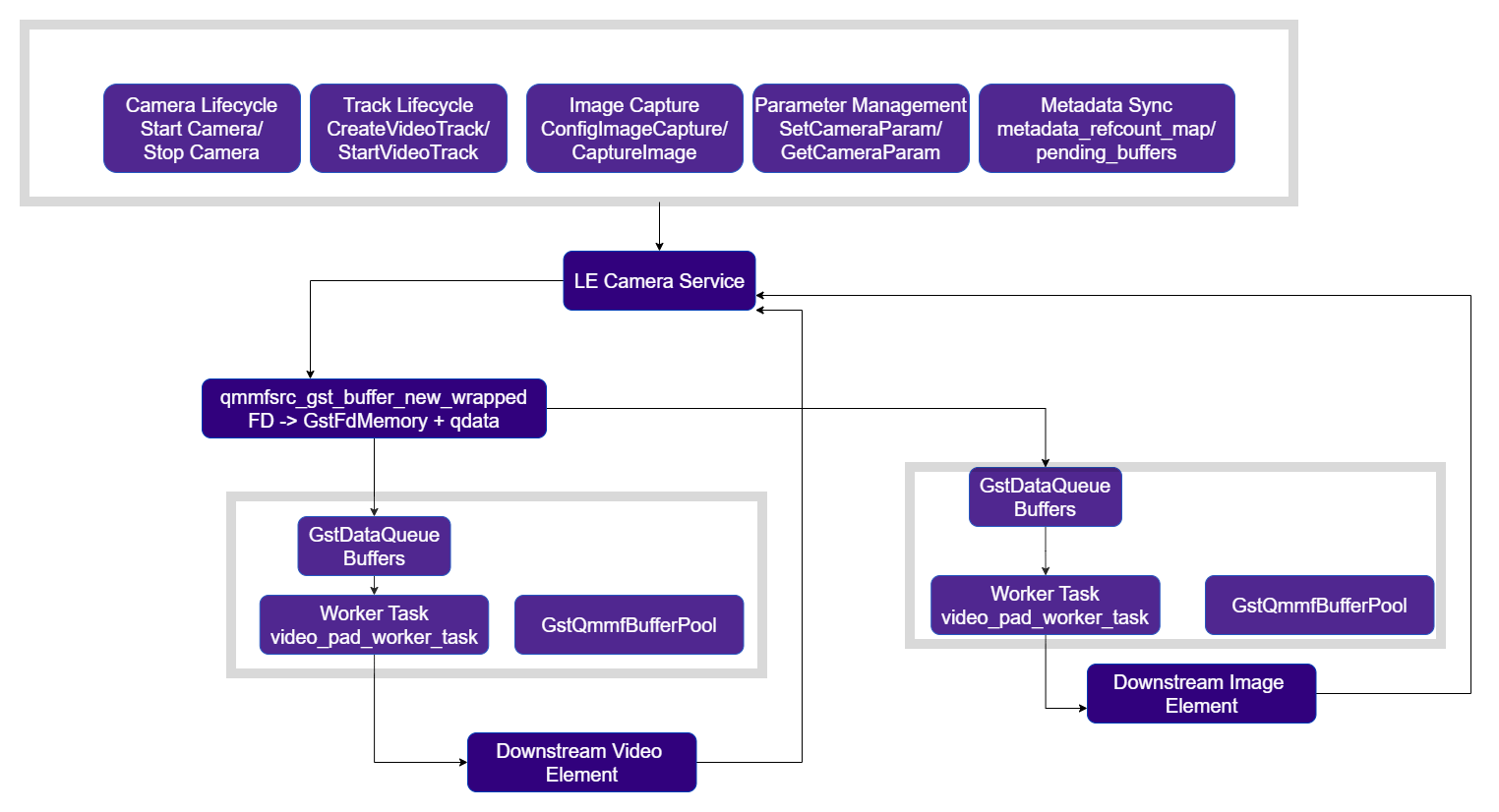
qticamsrc is built around a client-server camera architecture in which the GStreamer element acts as a client of the camera service. The camera service manages the underlying camera HAL, stream creation, buffer allocation, and capture control, while qticamsrc exposes those capabilities to the GStreamer pipeline through source pads, camera properties, and control signals.At a high level, the element:
opens and configures the selected camera device
creates and manages video and image output streams
receives captured frames from the camera service
wraps camera buffers as GstBuffer objects
pushes those buffers downstream through the corresponding source pads
returns buffers to the camera service when downstream processing is complete
This design allows qticamsrc to provide zero-copy camera output while keeping ownership of camera buffers and stream resources in the service layer.
A C++ wrapper around the camera service API. It is the primary interface between the plugin and the camera service, and is responsible for camera open and close operations, stream creation and deletion, image capture requests, translation of plugin properties into camera metadata, and per-frame metadata synchronization.
GstQmmfSrcVideoPad — video output pad implementation
A custom pad implementation used for each video_%u source pad. Each video pad owns its own queue, worker thread, and reusable buffer pool. Frames received from the camera service are queued per pad and then pushed downstream asynchronously.
GstQmmfSrcImagePad — image capture pad implementation
A pad implementation used for each image_%u source pad. It is similar in structure to the video pad implementation, but is used for still-image capture workflows rather than continuous video streaming.
A lightweight buffer pool used to reuse GstBuffer wrapper objects. The pool does not allocate camera memory itself; instead, it provides reusable GstBuffer shells that are populated with camera-provided DMA-backed memory when frames arrive.
The operation of qticamsrc is closely tied to normal GStreamer state transitions.NULL → READYThe element opens and initializes the camera device selected by the camera property.READY → PAUSEDThe negotiated pad capabilities are translated into camera stream configuration, and the required streams are prepared through the camera service.PAUSED → PLAYINGThe prepared streams are activated. For video pads, capture requests are submitted and frame delivery begins.This state-driven design ensures that camera initialization, stream setup, and frame acquisition are aligned with the pipeline lifecycle.
Video pads (video_%u) produce a continuous stream of buffers at the negotiated frame rate. They are typically used for:
preview
video encoding
display
streaming
AI inference
Each video pad can be configured independently. The camera service selects an appropriate internal buffer count based on stream properties such as resolution, format, and frame rate. If additional buffering is required, it can be requested through the extra-buffers property.Video orientation can be adjusted in 90-degree increments through the rotate property.For high-frame-rate operation, when the negotiated frame rate is 60 FPS or higher, the stream enters HFR mode. In this mode, the super-buffer-mode property becomes available. When enabled, a single GstBuffer may contain multiple captured frames. The number of frames per buffer is computed as:frames per buffer=60negotiated frame rateFor example, at 120 FPS, each output buffer contains 2 frames.By default, video pads begin streaming automatically when the element enters the PLAYING state. This behavior can be changed through video-pads-activation-mode. When configured for signal-based activation, streaming starts and stops only when controlled explicitly through the video-pads-activation signal.
Image pads (image_%u) are used for on-demand image capture. Unlike video pads, they do not stream continuously. Image capture is triggered by the application through the capture-image signal, which specifies:
the image type
the number of images to capture
optional camera metadata
If multiple image captures are requested, the operation can be canceled through the cancel-capture signal.Image orientation can also be adjusted in 90-degree increments through the rotate property.The number of simultaneously supported image pads is platform-dependent. All supported platforms allow multiple video pads, while support for multiple image pads depends on chipset capability.
When a frame is received from the camera service, qticamsrc obtains a reusable GstBuffer wrapper from the corresponding pad’s GstQmmfBufferPool. The incoming camera buffer is then wrapped as GstFdMemory, and the resulting GstBuffer is queued on the target pad.Each source pad has its own internal queue and worker thread. The worker thread dequeues buffers and pushes them downstream through the connected GStreamer pad.This design separates:
camera callback handling
buffer wrapping
downstream gst_pad_push() execution
As a result, frame acquisition remains decoupled from downstream pipeline timing, which helps maintain stable capture behavior even when downstream elements operate at different speeds.Buffers produced by qticamsrc are DMA-backed file-descriptor buffers, making them compatible with zero-copy downstream processing when the rest of the pipeline supports FD-backed memory.
Each video pad and image pad owns a dedicated GstQmmfBufferPool. This pool is used only to reuse GstBuffer wrapper objects and reduce the overhead of repeatedly creating and destroying GStreamer buffers.The pool behaves as follows:
it maintains a small number of reusable GstBuffer shells
it does not allocate the actual camera frame memory
frame memory is attached later when a capture callback is received
when a buffer is returned to the pool, the wrapper is cleaned by removing attached memory and auxiliary data before reuse
This keeps wrapper reuse efficient while ensuring that stale memory references are not retained across frames.
The actual frame buffers are allocated and owned by camera service, not by qticamsrc plugin.When a frame arrives:
the camera-provided file descriptor is wrapped as GstFdMemory
the memory is marked with GST_FD_MEMORY_FLAG_DONT_CLOSE
GStreamer is therefore prevented from closing the underlying file descriptor
Additional buffer return information is stored with the GstBuffer so that the plugin can return the buffer to the camera service when downstream processing is complete.When the final reference to the GstBuffer is released:
a cleanup callback reconstructs the information needed to identify the original camera buffer
the buffer is returned to the camera service
any associated metadata references are released
This mechanism ensures that buffers are safely recycled back into the camera pipeline while preserving zero-copy delivery downstream.
qticamsrc supports attachment of camera metadata to captured frames. When metadata attachment is enabled for a video pad, per-frame camera metadata is matched to the corresponding frame using timestamps before the buffer is pushed downstream.The element also exposes a range of camera-control properties that map to underlying camera metadata settings, including controls for tuning and capture behavior. These settings provide a GStreamer-facing interface for configuring standard camera parameters and Qualcomm-specific camera features.
The camera device used by a qticamsrc instance is selected through the camera property. If no camera is specified, the element uses the first detected sensor by default.Under normal operation, multiple instances of qticamsrc cannot open the same camera ID at the same time. An exception exists through slave mode:
a primary instance owns the camera and controls its configuration and lifetime
a secondary instance can access the same camera by enabling the slave property
In slave mode, the secondary instance can request additional output streams from the same camera, but it cannot:
change camera tuning parameters
modify camera settings
control camera lifetime
This allows multiple GStreamer branches or clients to share the same physical camera while keeping ownership centralized in the primary instance.
qticamsrc also supports multi-camera workflows, where each plugin instance corresponds to a single physical camera device. This allows applications to instantiate multiple qticamsrc elements to access and process streams from multiple cameras concurrently. For example, a dual-camera configuration can be implemented by creating two separate plugin instances, one for each physical camera. The maximum number of cameras that can be used simultaneously is determined by the hardware capabilities of the target Qualcomm chipset and its ISP capabilities.
# Replace $HOME to the appropriate device path before running the commands.# For QLI: /root# For Ubuntu: /home/ubuntu# Modify this based on your platform and ensure files are copied to the correct location on the device.# Run from your host machine — replace <user> and <device-ip>ssh <user>@<device-ip> "mkdir -p $HOME/{media,media/output}"
2
Connect to device
# Run from your host machine — replace <user> and <device-ip>ssh <user>@<device-ip>
This example demonstrates a live camera preview pipeline that captures 1080p frames from the ISP camera using qticamsrc and renders them to the display using the waylandsink plugin.
This example demonstrates live snapshot capture while a live preview stream continues to run in parallel. The gst-pipeline-app application is used to trigger the capture signal while the preview pipeline remains active.
#Choose options in the order displayed.#Use the alpha-numeric characters displayed corresponding to each of the below options:PLAYINGPlugin Modecamsrccapture-imagestill3
This example demonstrates simultaneous capture of two output streams from the camera source plugin. Both streams are processed in parallel, encoded independently, and then muxed into MP4 output.
This example demonstrates simultaneous camera capture for three parallel streams: a live preview stream, a 1080p H.264 recording stream muxed into an MP4 file, and a periodic JPEG snapshot capture stream.
#Choose options in the order displayed.#Use the alpha-numeric characters displayed corresponding to each of the below options:PLAYINGPlugin Modecamsrccapture-imagestill3
This example demonstrates a dual-camera pipeline in which each camera produces two output streams. One stream from each camera is composited side-by-side for live display, while the second stream from each camera is encoded independently and saved as an MP4 file.