

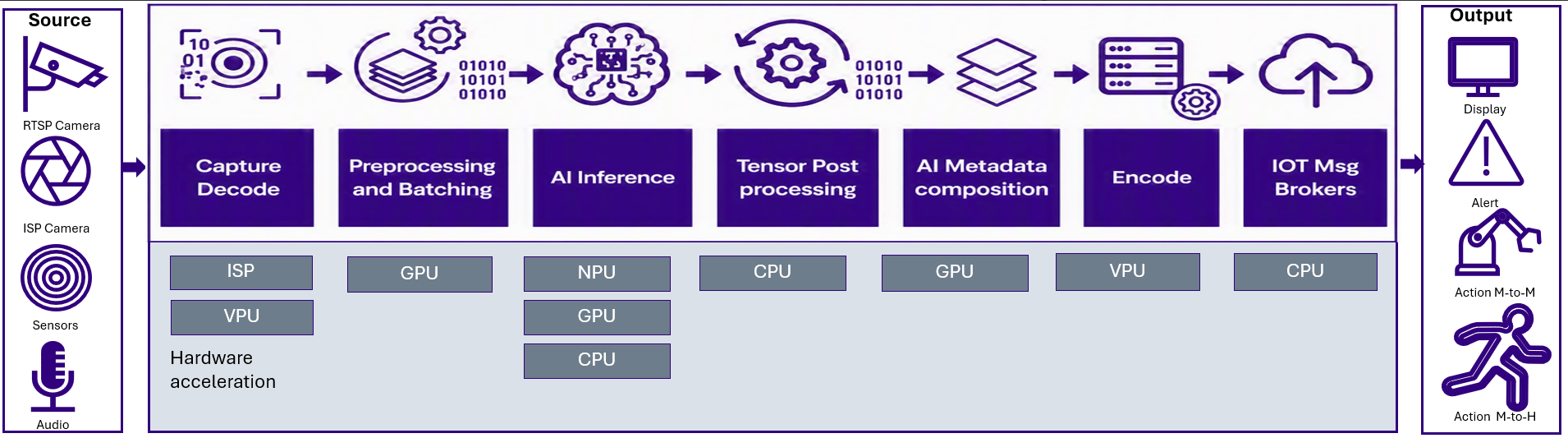
The Qualcomm® Intelligent Multimedia SDK (QIM SDK) is a comprehensive, hardware-accelerated multimedia and AI framework that empowers developers to rapidly build, deploy, and scale intelligent vision, audio, and AI applications on Qualcomm® platforms. Designed for developers, solution integrators, and OEMs, QIM SDK simplifies the creation of advanced edge AI solutions across a wide range of IoT segments, including smart cameras, robotics, drones, home appliances, AI appliances, and connected devices. QIM SDK HW pipeline QIM SDK provides the flexibility to develop applications using the programming environment that best fits your expertise and workflow. Developers can build AI-powered multimedia pipelines using native GStreamer, C++, or Python, enabling both low-level optimization and high-level application development. This flexibility significantly reduces the learning curve and accelerates adoption across diverse developer communities.
  • Python App Builder — Simple, high-level syntax for fast prototyping and rapid iteration on multi-stream, daisy-chained pipelines with fine-grained control.
  • C++ App Builder — Low-level control and minimal runtime overhead for building high-performance, production-grade multi-stream, daisy-chained pipelines.
  • GStreamer App Builder based native SDK — HW acceleration across Camera/ISP, GPU, Video, Display, IoT protocols, streaming.
  • Coding Agent — Agentic, skill-based coding agent that generates and deploys applications across all three App Builders (Python, C++, and GStreamer).
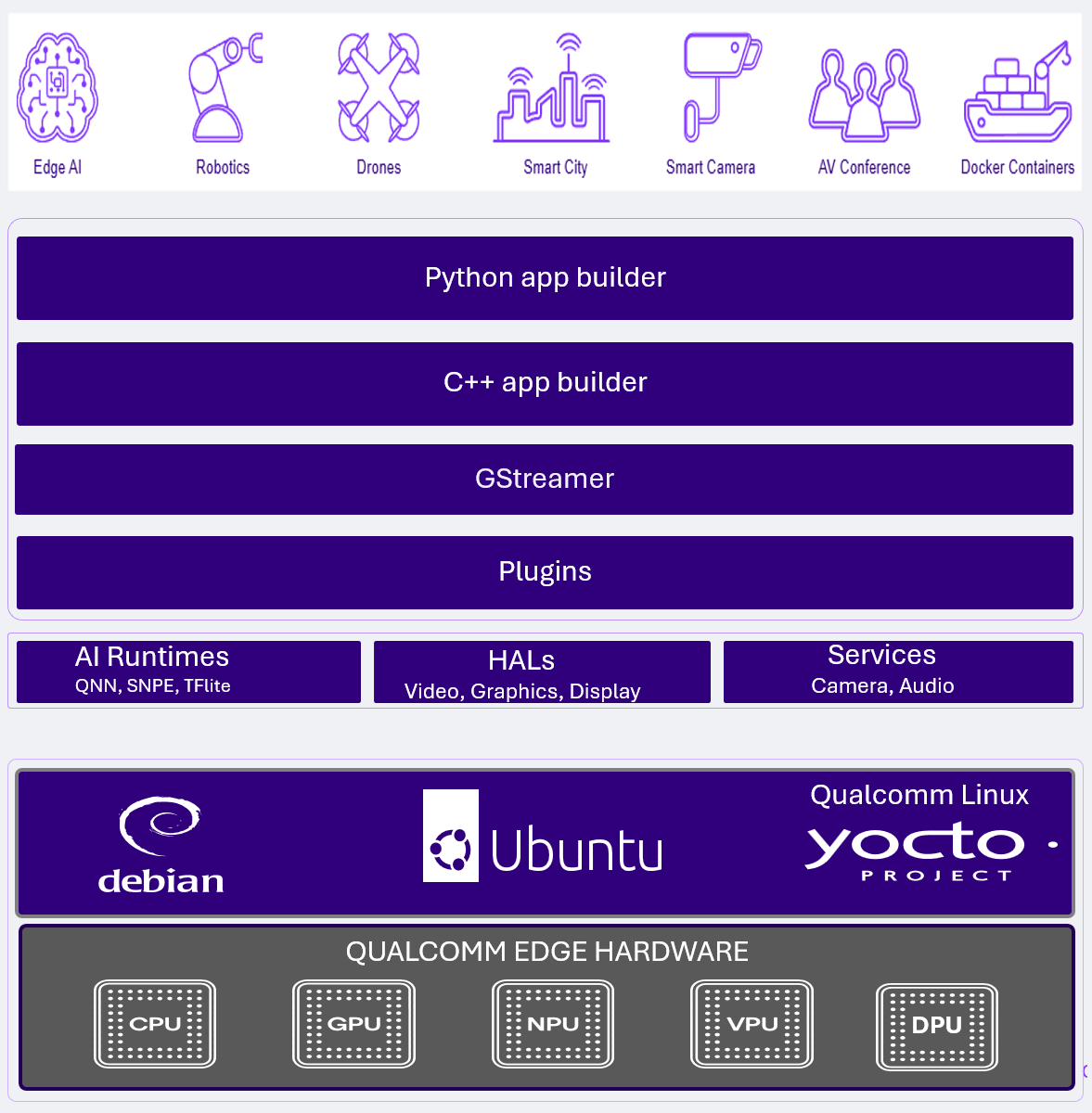
QIM SDK HW pipeline To further streamline development, QIM SDK includes AI-powered Coding Agent capabilities that assist developers in building, optimizing, and integrating AI and multimedia pipelines more efficiently. By reducing manual effort and simplifying complex workflows, the Coding Agent helps accelerate application development and improve developer productivity. With QIM SDK, developers can rapidly compose and deploy single-stream or multi-stream AI applications while leveraging the full capabilities of Qualcomm® SoCs, including:
  • Neural Processing Units (NPUs) and AI accelerators
  • Video encode and decode engines
  • Camera Image Signal Processors (ISPs)
  • GPUs and display subsystems
  • Audio DSPs and multimedia accelerators
The SDK’s modular, plugin-based architecture abstracts hardware complexity and eliminates the need for extensive platform-specific expertise. Applications can be developed once and deployed seamlessly across multiple Qualcomm® chipset generations and product tiers, enabling portability, scalability, and faster time-to-market. By combining hardware acceleration, multi-language development support, AI-assisted coding capabilities, and platform portability, QIM SDK enables developers to focus on innovation and deliver high-performance intelligent edge solutions faster and with greater efficiency.
1

Setup the SDK

Get the QIM SDK installed on your Linux device
Go to Installation
2

Create your first AI pipeline

Create a simple Hello World style AI pipeline
Go to Quickstart Guide
3

Understand the main components of an AI pipline

Learn to capture video and audio from a device, preprocess inputs, run AI inference, and interpret the results
Go to Building AI Pipelines
4

Explore features of QIM SDK

Browse sample pipelines and code, dive into advanced features and containerization, and reference the full plugin documentation

What do you want to do?

Installation

Install QIM SDK on your Linux device.

Building AI pipelines

Learn how to quickly build AI pipelines using the provided examples.

Plugin Documentation

Reference documentation for all QIM SDK GStreamer plugins.

Release Notes

View the latest release notes.

Need inspiration?

AI pipeline examples

View complete end-to-end pipeline examples you can leverage.

See code samples

Get started with Python, C++, and GStreamer code samples.